Pages

Tuesday, June 27, 2017

Can you *really* do that on mobile? (whatever "that" may be)

I'm writing this following a thread I saw a while ago in the Designers for Learning LinkedIn group re the mobile design sprint and the viability of mobile-based activities on the web (that I can't seem to find now on my phone 😀).

Questions were raised regarding how practical it *really* is to use mobile for developing, delivering and consuming online content. There's no question that mobile-based computing has its limitations. There's also no question that it's amazing what can be done if constraints dictate that mobile access is your only option.

Advancements in device and web technologies mean that mobile-based computing is more viable now than ever. Developers are becoming increasingly conscious of the needs of their mobile users. Devices themselves (Android OS in particular) are becoming more powerful, with larger screens. More processing capacity and more screen real estate to work with, give designers and developers more options when considering how best to reach their mobile audiences.

It also bears noting that, for many, there are no options. Limitations, be they circumstantial, financial or technical, mean mobile is the only way to connect. If inclusion is part of what you see as your mandate as a designer, then you owe it to yourself, and your audience to account for mobile users in design and development content.

There's nothing like finding oneself in a situation with no option for connecting, other than mobile,  to give a very clear sense of the importance of accounting for the mobile user when designing and building content for online delivery. This is particularly true in emergency preparedness and outreach situations. Your audience may have no other way to access and engage with you and your content.

All stakeholders stand to gain from a design and development philosophy that accounts for mobile. From design, through development to the consumption of content and contributions to the community, spreading the access and inclusion net as wide as possible is a good thing. Notwithstanding the fact that it's the right thing to do, it will help sharpen the design and development process. It also has the added benefit of pretty much ensuing access and inclusion for all.

If you can make it work on a phone or tablet, it's pretty much a given that it'll work on a computer. Of course there will always be things that can't be done on mobile (until you figure out how 😎). At the same time, as designers, developers, and users push the envelope on what's possible/practical via mobile, the better the experience will be for all.

Wednesday, May 06, 2015

#rhizo15 content: media for dialup

what good is content that can't be accessed?

how accessible is your content?

how do you know?

#rhizo15

#throwbackrhizo


Saturday, April 25, 2015

Week 2 #justlakeit #oeglobal #rhizo15: assess this

I'm a big fan of open education resources (OER) and an even bigger fan of Banff National Park, so I welcomed the opportunity to attend the Open Education Consortium's 2015 conference with open arms. I'm primarily attracted to Banff due to its proximity to some of the best skiing in the world, and mine to it (it's a 100 km from my door). 

I played hooky from the pre-conference workshop and did some professional development at Lake Louise Ski Resort. I learned a lot (and yes, I did share the notion of "learning subjectives" with my instructor during the lesson). #jusklakeit

We worked on technique which had me turning my skis as I'd never before (remarkable to me given my 30+ years skiing experience, and the previous certification as both a coach and an instructor). 

This change in technique also meant the use of different groups of muscles in my legs, which turned to rubber in very short order. Both of these were very subjective forms of assessment; however, my instructor, Tom Bazley was able to see the difference in the turns and we got all subjective from there.

After the lesson, I fired-up TraceUp. See below for the "objective" assessment results:

Managed to tear myself away from the Inn and get myself to the Lodge for:


This was my first trip to #oeglobal and I didn't know what to expect.....

My first impression of the conference common space itself, was: 
"Whoa, there are lots of suits in here...." 
Why this was the case? My best guess was that many attendees held "more senior" positions within their respective organizations. 


NOTE: While the pre-conference Open Advocacy Day at Open Education 2015 required formal business attire, that was on Capitol Hill, Washington, DC and organizers had prescribed the dress code in that instance)

As you might have already guessed, many of those wearing suits were older, most were Caucasian, and nearly all were male..... 

[Full disclosure: I pretty much fit the profile, right down to the suit--although I did opt for jeans, t-shirt (of the #ForkU #rhizo15 variety no less ;-)) & jacket on the last day of the conference].


Stephen and me

I've long been interested in "accessible" and "open" most particularly in information and communications technology implementations.

I have a tiny instructional design and learning development company. My work with corporate clients allows me to pay my bills, and to be a patron of the arts. 
I often refer to myself (and I'll leave it to you to decide how much of a joke this is) 
as a corporate whore. 

Notwithstanding the degree to which I have to "sell out" to keep the lights on,  it's important to me to conduct myself in a socially responsible manner and remain a contributing member of my community. More about that later....

I see a big part of my work toward "social responsibility" to be in fostering openness when and where I can. As I see it, this means spreading the word to whomever will listen  and to educate anyone who'll listen on the value of Creative Commons licensing of materials, and particularly CC-BY and CC-0.  

On the topic of CC licenses--to both the amusement and consternation of some at the conference, because I kept bringing it up--I have particular issues with the CC-NC license. 

Before embarking on my rant, I'll recognize the fact that developers and producers are free to license their materials however they wish. That said, I'm not sure how many consumers and developers appreciate the implications of the "non-commercial" license.

For example, one of the graphics rolling over on the front page of the conference website--the pretty scenery one with the lake, mountains and trees, entitled Banff, Alberta Canada--is tagged with a CC-BY-NC-SA license. 

Since organizers charged a fee to attend the conference, the NC prescription of this license means that it shouldn't be used here--or whatever agreement reached with the photographer would have made a caption/title "used with permission" more apt. Who cares? This amounts to no more that a tempest in a teapot--right up? I'd say sure, it does. Right up until it doesn't....

Notwithstanding my obsession with licensing, its gratifying to see overall attitudes toward small businesses changing for the better:

  • notions of revenue and sustainability aren't as dirty or untouchable as they've been 
  • small businesses which believe in the efficacy of open are welcomed to the table
  • there's space for all who support development, research, and use of all things OER 

Since Week 2 of #rhizo15 week has been brought to you by the word measurement, I'll measure #oeglobal as successful as evidenced by this list of open educational resources-based small businesses. 
Each run by a real person, who's passionate about open. 
Each intent on making OER accessible, relevant, and sustainable:


I'll sign off with one more measure of success. 
These organizations provide resources, strategies and support for those looking to adopt and leverage open educational resources for self and community:


Saturday, April 18, 2015

A retrospective for #rhizo15--subjectively speaking

This retrospective is something I'm posting because I'm:
  • not sure how else to provide an introduction piece for #rhizo15
  • hoping it'll further my own understanding of how I got here
  • sure it'll be highly subjective 

I grew up in a small, rural town in Ontario, Canada. Very early on, I got the sense that there was much more out there, and I'd do well to "get outta Dodge" and seek experiences in the larger world.

 A month after my 18th birthday, I dropped-out of high school, packed-up what belongings I could fit into a backpack, and hitchhiked the 3250 km to Calgary.  This adventure was filled with experiences--some more positive that others--and drove home the realization: I really  learn when I'm pushed out of my comfort zone.

My experience on road construction, as a surveyor's assistant, landed me a similar gig working on seismic exploration crews, based out of Calgary. We spent the fall working hot-shot (per-diem) living out of motels in southern Alberta and Saskatchewan), and in the winter, after freeze-up out of camps (Northern Alberta, and NWT (as it was known then)) settings. This led to many more learning opportunities--perhaps chief among these being: "remaining in a remote camp for a month can result in 'cabin fever.'" 

I'd already planned to return to school for the winter semester, and I can tell you the month straight in camp did nothing to undermine the decision. This marked the first time a job experience sent me back to school. 

My return to school lasted until just after basketball season ended. It was then I retired from high school, for the second and last time, and returned to Calgary.

On the return to Cowtown, I decided it'd be a better idea to find a gig that would allow me to actually live and work in the city itself. Responding to a help wanted ad for "management trainees" resulted in me becoming a 3rd-party commercial bill collector. Perhaps the best thing I can say about this is that my teenage self had no real concept why this might have been a bad idea from day one. "Ever since a bad day at work" has had an entirely different context.

Following a couple of years, and transfers to Edmonton and Toronto, this was the second job experience which sent me back to school. This time as a non-matriculated pre-university student at Woodsworth College--University of Toronto. What awaited in the working world ensured that I was a much more motivated learner than I'd been on my first return to school. I began night classes in the spring, and was a full-time undergrad at New College by the fall.

After completion of my undergrad (in English) I returned to the my home town to be with my father, prior to his death from cancer. I'll spare you all the gory details and just say that I'll forever be grateful for the opportunity to at least begin remediation of the relationship we shared before he was claimed by this particularly nasty disease.

It was also during this time that I got my first experience as an educator. I signed-up on the supply teacher list at a high school in my home town. My first day was with a "special education" class comprised of "behaviourally exceptional" students intent on making short work of the newest candidate for the position of Mr. Spence's substitute at the school. It was mid-October and I was the 10th contestant

After day one, I visited the office to return the classroom key. The school secretary asked, "How was your day?" She seemed a little puzzled when I responded, "great, have me back any time...." (It was only later that I found out that I'd been the 10th contestant!)


By the end of that school year, I'd been hired as the permanent supply teacher, and had been designated at the principal's proxy for discipline at the school. I'm especially proud of this fact, because:

  • I was hired as a non-Catholic by a Separate school board--apparently very rare
  • I was able to make a positive impact at the classroom, school, and board levels
  • I did all this without a teaching certificate
I moved on to youth work following this, and remain an advocate for youth who've be labelled, ghettoized or otherwise marginalized. In more recent times, this involvement has been, and is, on a volunteer basis with various employment, mental health, social service initiative--both at the board, and "front line" level. 

My mother taught me very early that volunteering and contributing to your community is a critical aspect of being a citizen. My first formal volunteer position was a member of the Gatineau Zone: Canadian Ski Patrol System--the only zone in the country which permitted recruits as young as 16 years of age.


To this day, it grates when someone tells me they're "giving back." It's all I can do not to scream:

YOU'RE NOT GIVING BACK! YOU'RE BEING A CONTRIBUTING MEMBER OF YOUR COMMUNITY. WHO SAYS THEY *WANT* WHAT YOU HAVE TO *GIVE* ANYWAY?

The mid-90s represented yet another return to Calgary. Ultimately, this led to another job experience resulting in a return to school. I'd decided that given the opportunities, it'd be a good idea to secure employment in the recreation sector. Calgary is the closest major centre to some of the best recreational opportunities on the planet, year round. I settled on golf and skiing, with a side helping of snow boarding--which brings us....

The precipitous learning opportunity took me WAY outside my comfort zone. I'm here to tell you a broken wrist will do that. I learned it's very good idea to always wear wrist guards when snowboarding. I also learned:


  • there's an acronym for this type of injury: FOSH (fall outstretched hand)
  • the scaphoid bone's blood supply makes it particular susceptible to avascular necrosis
  • this type of injury takes a long time (12 wks) to heal and/or often requires surgery 
The day before I'd signed-on to work year-round for the company which owned the resort in question, along with a series of others. Six weeks later, when I showed up to work summer lift maintenance with a cast on my wrist, their occupational health and safety department wouldn't let me on site and I was laid off. I ended-up at the employment insurance office to file for benefits and to see what options there might be for education/retraining. This led to enrollment in a fast-track, object-orientation software engineering (OOSE)program at the Southern Alberta Institute of Technology.

My OOSE certificate, BA in English, and practical experience in education led to various technical writing, curriculum development, facilitation and training gigs for corporate, educational, government, non-governmental organizations audiences. It was during this time that I became the Training Developer by SMART Technologies Inc or, as I was fond of calling myself, "Employee Zero" of their training department. It also prompted the latest entry on my "return to school job experience" list. While at SMART I applied to the Ontario Institute for Studies in Education at the University of Toronto (OISE/UT) to complete a M.Ed degree in Curriculum, Teaching and Learning with a specialization in Computer Applications. I choose this program since it would allow me complete degree requirements remotely, while also travelling 80% of the time conducing face-to-face training sessions for SMART (if you attended a SMART Board interactive whiteboard Masters Session in North America between 2001 and 2004 there's a good chance we've already met ;-)

I have to end there (thank goodness exhaled the .0004% of you who've made it this far) and will be back with more regarding the last decade, although much of that may be found scattered across various communities, networks and spaces of the world wide web. And, especially in terms of how I got here, I'd be remiss if signed-off without at least mentioning my introduction to Jeff Lebow and Dave Cormier and EdTechTalk a decade ago.


Saturday, April 05, 2014

And now onto #PKMastery

While I don't have the time to commit to the extent I'd like, I've taken the plunge and enrolled in Harold Jarche's Personal Knowledge Mastery course. Looks like a capable, engaged group of participants and, less than a week in, I've already learned about new resources and practices that I've been able to apply to my consultancy. As always, stayed tuned to this space for details

Thursday, February 13, 2014

Is books making us stupid? #rhizo14

In a word; yes.

There are very few absolute, definitive truths. One “fact” I like to cite when challenged on this, is the number of planets in our solar system. Once Pluto was downgraded to an asteroid weren’t all bets off? 

Indeed the relation of earth to other planets, to the sun, and even if it’s indeed round (or at least non-flat) are all topics that have been written about, and considered absolutely true, and subsequently “corrected” over the course of history.

The process of capturing and recording “data” or “facts” or moving from the relative to the objective as Dave describes it in his video, begins the process of obsolescence for that particular volume.
The corporate world understands and accommodates the fact that capturing information dooms it to irrelevance by:
  1.  Incorporating dates into file names as part of prescribed naming conventions
  2. Using “track changes” in word processing software like Microsoft Word
  3.  Taking advantage of the version control capacities and methodologies “baked into” content management systems like Livelink and Sharepoint
  4. Referencing  “living documents” to make it explicit that consumers of said material can expect changes (and will need to know how to distinguish/where to find  current vs. previous versions)

Of course the challenge—no matter one’s area of endeavour or discipline be it corporate, educational, medical, political, social or whatever combinations thereof—in all of this is determining how to mediate the flow of information and arrive at what constitutes “truth” or the right (at least for now) answer? 

How do we accommodate the uncertainty which some believe (and I’ll include myself in this group) essential to truth-finding and sense-making? How do we keep the quest for knowledge relational (along the lines of the oral traditions Dave mentions in his video) and allow for the betterment and development of the existing canon in a given subject area?


One approach may be to embrace the stupid (along the lines of uncertainty for those so inclined) as proposed by Neil Postman and brought to my attention—perhaps not surprisingly—by one of the most inclusive and open instructors, Trevor Owen, I had during my M.Ed studies at the Ontario Institute for Studies in Education at the University of Toronto.

Wednesday, January 29, 2014

willing suspension of certainty #rhizo14

From my vantage, there's value in Coleridge's willing suspension of disbelief when contemplating the notion of embracing uncertainty, or the willing suspension of certainty if I may.

Being open to, or embracing, uncertainty also allows for outcomes beyond initial expectations.

Providing a group of learners with a challenge or goal, and leaving them to their own devices as to how to solve the problem, or reach the desired outcome(s) may result in solutions which ultimately exceed the expectations of all involved.

Of course, this dynamic will only be possible in environments or situations in which uncertainty is fostered and, in turn, provides the for the chaotic, messy, non-linear setting necessary for a given group of learners, or community, to marshall uncertainty and arrive at solutions beyond what is possible in prescribed, scripted environments. This is easier said than done, especially in formal learning environments; however, the benefits of such an approach can be measured in learner engagement and ownership of, and responsibility for, one's learning.

Thursday, January 23, 2014

(re)enforcing independence #rhizo14

How do we become more independent as educators, and engender independence on the part of our learners?

The environment in which we operate will obviously have a significant impact on how motivated we may be to exercise, and reap the benefits of, our independence.
As I was considering the topic of "enforced independence" it became apparent that conditions must be conducive to the independence of actors on a particular stage, or all the enforcement in the world will not do anything to make me independent. Without strategies, or a plan of attack, I'll not be able to be an independent actor in a particular environment. Challenging ourselves and moving outside comfort zones leverages independent learning strategies and helps us empathise with the issues faced by independent learners.

If you can teach yourself to do something by leveraging information and your networks, you'll be more able to expect this from your learners, and, more or, importantly better understand the challenges they'll face in their quest to exercise independence.

In the spirit of "moving outside comfort zones"/"expanding one's horizons" I've decided to take advantage of the 3rd birthday celebrations for #ds106radio to see if I can teach myself to webcast from my phone. Many of you will be familiar with, or indeed a part of, the community that's developed and evolved around #ds106 and #ds106radio is dynamic and vibrant. All are welcome to participate, and those who'd like to take the stream need only tweet with the #ds106radio tag to signify intention and 'cast away.

Today I had a chance to review the connection and broadcasting details, linked from a tweet by @cogdog (Alan Levine), for Android. I've done a fair bit of computer-based webcasting over the years, and I'm hoping to get well outside my comfort zone and contribute birthday wishes, and celebrate #ds106radio, from my phone. Wish me luck ;-)  

UPDATE: It worked! Thanks for shoutouts Alan Levine and Leslie Lindballe

Turned out to be a very busy day online. In addition to my first mobile webcast (aka #traincast) on #ds106radio to send along my birthday wishes, this day included:

  1. Online meetings with work colleagues for a project status update and a software installation walk-through
  2. Poked my head into a Designers for Learning session hosted by Jennifer Maddrell
  3. Participated in the Unhangout for #rhizo14 and take part in the breakout session for "Independence in Everyday Life" breakout group with Aaron, Carol, Jim and Vanessa
All of this served to (re)enforce my belief in the fact that independence, and exploring and taking advantages to connect, is key to one's success in online environments

Monday, January 20, 2014

More on cheating as learning #rhizo14

I mentioned the other day that I've been pondering how the notion of "cheating as learning" may apply to business and recreational pursuits. And while I'm still not entirely sure how the notion relates to each environment, I'm hoping you'll bear with me as I attempt to "talk it out" in this space (and please do comment/cajole/deride as you see fit ;-)

Following on Peter's post on "breaking away" from the rules, rather than contravening a particular rule itself, I think there's benefit in an exploring rules, or current standard operating procedures, with an eye to improving performance, increasing safety, or working toward whatever a particular desired outcome may be. Too often we fall into the trap of "we've always done it that way" without critical assessment of how me might do a better job of leveraging available resources to perform a task, or ensure an outcome.

In our breakout discussion during the unhangout, Jim Stauffer mentioned that we'd do well to focus on goals, rather than rules, and that it can't be considered cheating if one is focusing on, and working toward, a particular goal. If rules preclude me from attaining my goals, do I have an option other than "cheating" to attain my goal?

In the business world, instructional designers and training developers develop documents called "cheatsheets" which are used as performance improvement tools and provide "just in time" quick reference for those charged with completing a task, or operating a software application. In this instance, the "cheating" being done amounts to referring to a one-page document, rather than having to locate a reference to the specific procedure or task in an owner's or operator's manual. Keyboard shortcuts and data entry codes are also referred to as "cheats" in some software applications. 

Workarounds (a circumvention of the way you're supposed to do something might also be referred to as a "cheat") are a big part of getting stuff done in business environments--especially those with a variety of software applications, operating systems, and connection speeds. One size most definitely does not fit all, and accommodations have to be made, for differences in technical acumen, connection speeds and operating systems. 

In the recreational world (and particularly ski resorts) "cheating" can take a number of forms. For instance in the past couple of weeks, skiers have "cheated" the boundary of the ski area in search of untracked power snow and have found themselves stranded and in need of rescue by Park Wardens slung under helicopters. I'm not sure what's been learned by those requiring rescue. Maybe they learned that the pursuit of fresh tracks in powder snow isn't worth risking your life (or endangering those charged with effecting your rescue)--one can only hope.

In an attempt to bring this stream of consciousness to a close I'd say that I "cheating" as an accepted practice provided it serves larger or ultimate goals, is in keeping with the spirit of how one sees one's role in an organization, and doesn't impune the interests, or safety, of others. 

Wednesday, January 15, 2014

Cheating as Learning #rhizo14

I like what Dave has to say in his Cheating as Learning video, especially regarding the locus of power which accrues to those with "the answers" in a given environment. As he indicates, we've typically been dissuaded from collaborating or sharing answers and solutions to a particular problems or questions, because this has been deemed to be "cheating."


"Do your own work," we've been told since grade school.


For me the crux of the matter comes down to intent:


Why exactly is it that you're cheating?


If cheating is indeed to be used as a weapon, I'd suggest that it be used for goodness as opposed to evil; that said, who becomes the arbiter of what constitutes "good" and "evil" in a given environment or situation?


GOOD: During my time as a student at the Southern Alberta Institute of Technology the more proficient of my peers had developed computer science skills through the use of game cheats, and the understanding this provided of the underpinnings of the games they were playing. Developing, discovering, implementing and sharing these "cheats" allowed these individuals to develop a fluency and proficiency in both the code and social milieu in which it was developed and evolved. In this instance, cheating was used as a weapon to make games more accessible and playable for a wider audience. Those developing the cheats gained status and "cred" and many of these individuals have since parlayed this foundation into careers in computer science.


EVIL: During this same period of time, the same group of individuals commandeered a series of servers within the institution to mount a Quake deathmatch which involved hundreds of students across the campus and essentially amounted to a denial-of-service attack for "legitimate" users within the college. Those responsible were reprimanded, and levels of security were added to guard against a repeat of the situation. No one was was expelled or punished academically for their actions. While the institution may have considered their actions "evil" most of those involved did not, and my impression was they saw this experimentation as a natural extension of the "cheats" they'd initially developed for client machines.The whole notion of cheating as learning has my head spinning (like that's news if you've made it this far into this post) and has me thinking of the concept of "stupidity as a teaching tool" and a post I made to this blog in 2002


What if there are no right answers?


Is there any use in cheating to get the wrong answer?


I mentioned earlier today that I was contemplating the notion of "cheating as learning" as it might relate to corporate (i.e., #cubefarm) and recreational (i.e., ski resort) environments and I'm still struggling with how the implications and repercussions of cheating in both might manifest itself. I seem to keep coming back to intent--why are you cheating, and what to do you intend to accomplish? I need to consider these topics in more detail and will be back with more musings as time permits.


Thanks for reading, and to Dave for a provocative start to #rhizo14

Monday, January 13, 2014

About me #rhizo14

My name is doug symington and I've been interacting, learning and playing in online spaces since before the turn of the century.

From 2001 to 2005 I was an online MEd student at the Ontario Institute for Studies in Education at the University of Toronto (OISE/IT). My OISE/UT studies focused on Curriculum, Teaching and Learning with a specialization in Computer Applications.

This space resulted from my desire to attempt to capture some the coursework and concepts associated with my graduate studies at OISE/UT as well as space for reflection, and a diary of my learning both in and out of school.

During this same time frame I was employed as a Training Developer with SMART Technologies Inc., makers of interactive whiteboards and complementary/supporting software applications.

Throughout my time at OISE/UT and SMART I developed an awareness of the many issues related to "access" and online learning environments. I also became acutely aware that social relationships play a significant role in determining how motivated an individual learner will be to work through and overcome issues associated with access--be they technical, social or a combination thereof.

After leaving SMART I worked in the not-for-profits sector and worked with organizations on Vancouver Island leveraging "free" web tools for development and outreach across and within individual organizations. It was also during this time frame that I had the good fortune to meet @davecormier and @jefflebow and become a contributing member of the community they fostered with @edtechtalk. The many webcasting lessons I learned as a host of EdTechBrainstorm stand me in good stead to this day.

More recently I have returned to the corporate sector as a consultant; however, I continue to be involved in pro bono work for not-for-profits and remain *very* interested in exploring and leveraging "freely" accessible tools for the benefit of individuals and organizations--be they corporate, educational, or not-for-profits.

I've decided to participate in #rhizo14 to get back in with a community of practice of people who "get it" or are at least prepared to give online learning spaces a chance. I'd also like to make an effort to reflect more on my practice by blogging more regularly, and I expect #rhizo14 participation to prompt me in that regard.

I look forward to learning from and with each of you and am very thankful for the opportunity.

Thursday, January 09, 2014

obsolete and dead online spaces


If you've played in online spaces for any length of time, much of your content has probably been lost to the vagaries of dead, decommissioned, and obsolete spaces. Be it online course content, or one of the many "free" services that have been shut down over the years, you've probably lost at least a portion of your "artifacts" over the years.

This may, or may not, have prompted you to self-host your content in the hopes of have more control over the fate of your content, but even this approach is not a 100% guarantee of the persistence of your online "stuff."

Then again, you may have bet on the right horse (Blogger for example) and still have access to the stuff you posted a decade, or more, ago.

You can mediate the risk, and help to ensure persistence, by cross-posting your content across multiple spaces; however, if it's truly imperative that your loot persist--you'll want to have local (i.e., offline) and hard-copy versions of that which can not be lost.

Monday, January 06, 2014

Learning Diary Redux

This is a post from an #android tablet, and a "free" wifi connection. It also represents a resurrection of sorts of this space along the lines of its original purpose:a diary of my learning. My Learning Diary began some 12 years ago (almost to the day) as a repository for learning artifacts associated with my online M.Ed. studies at the Ontario Institute for Studies in Education at the University of Toronto (OISE/UT).

At lot of things have changed in online spaces in the interim, and a great many are still the same. One development I'm particularly interested in, are the advances in, and evolution of, self-organized social systems and how they've become part of the vernacular in the form of MOOCs and the like.

I've signed up for a course being run by Dave Cormier based on this model (that he and colleagues developed, notwithstanding what USA schools/corporations would have you believe).

What's the same now as it was then, are the human and social characteristics learners bring to any space, be it online or off, and intend to use this space to make (what I hope aren't TOO sporadic) entries related to my learning and observations of the process, and my reactions to the experience.

Sunday, August 12, 2012

Thursday, August 02, 2012

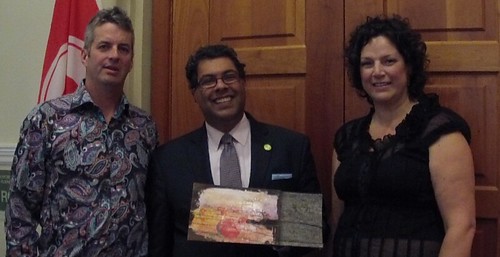
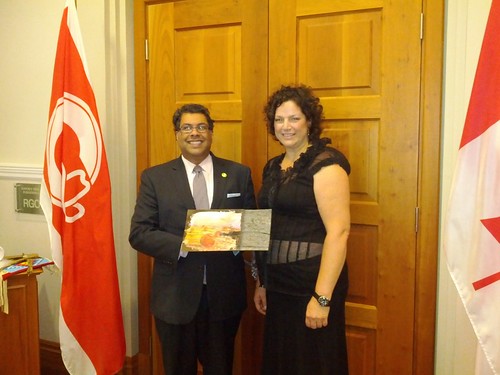
@karenscarlett and His Worship the Mayor

Think I was as excited as @karenscarlett when she presented one of her shingles to @nenshi today #yyc #art